Pac-Man: DevSecOps Delivery Pipeline
A delivery pipeline built around real release gates: blocking Trivy scanning, non-root hardened workloads, and a Kubernetes NetworkPolicy that restricts database access to the application Pods.
- DevSecOps
- Trivy
- Kubernetes
- Terraform
- GitHub Actions
Context
This project takes a supplied open-source Pac-Man application and builds a DevSecOps delivery pipeline around it. The application is not mine; the pipeline, runtime configuration and security controls are.
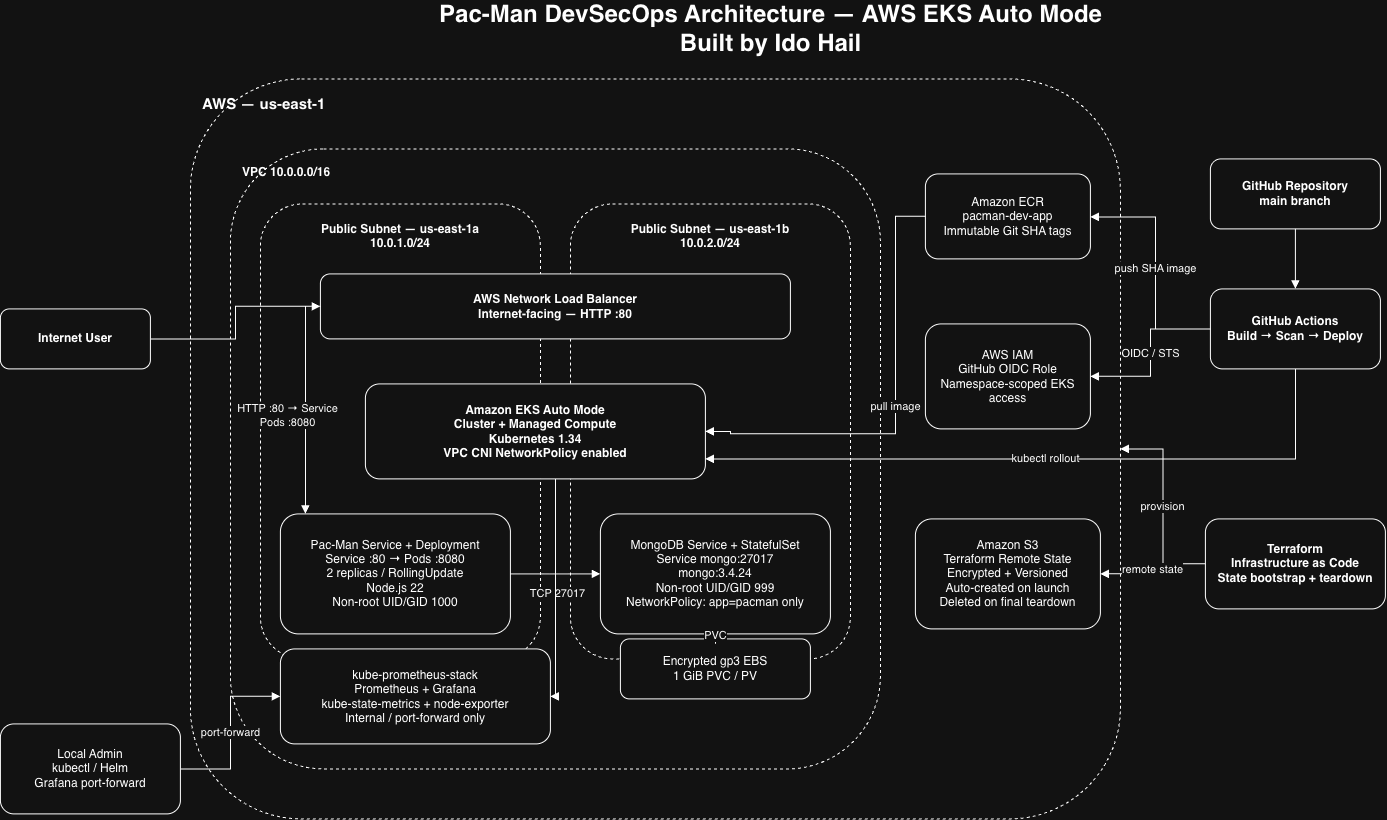
It shares infrastructure ground with NameGen (Terraform, EKS Auto Mode, ECR, OIDC, a Network Load Balancer, a MongoDB StatefulSet on encrypted EBS, Prometheus and Grafana), so that lifecycle story is not repeated here. This write-up covers what is allowed to reach production, and what it is permitted to do once it arrives.
Security gates
The supplied application carries legacy dependencies, so the pipeline has to handle imperfect input.
Trivy runs as a blocking gate. The build fails on fixable HIGH and CRITICAL findings in the image, while remaining findings stay visible for review.
npm audit runs as informational. The application’s legacy dependencies produce findings that cannot all be resolved without modifying an application that exists here as a payload. Blocking on them would stop delivery outright or create routine pressure to bypass the gate, so the image is held to a hard standard while the dependency audit stays visible without gating the pipeline.
Supply-chain pinning. The container base image is digest-pinned and the GitHub Actions are pinned, so a given pipeline run produces the same result instead of inheriting whatever a moving tag currently points at.
Workload hardening
The application runs as a non-root user with privilege escalation disabled and all Linux capabilities dropped. MongoDB also runs non-root. Both carry CPU and memory requests and limits, so a single misbehaving workload cannot starve its neighbors.
Rollouts use maxUnavailable: 0 with readiness and liveness probes, so a new version must report ready before the previous one is retired. A failing deployment stalls rather than taking the service down with it.
Network and database protection
A Kubernetes NetworkPolicy allows traffic to MongoDB on TCP 27017 only from Pods labeled as the application, which limits unnecessary lateral access inside the cluster.
Pipeline controls
Pull requests run the full validation path (Terraform formatting and validation, dependency install, audit, image build, non-root verification and Trivy) without deploying anything. Deployment happens only on push to main.
The OIDC trust is scoped to this specific repository and the main branch, and the CI identity’s Kubernetes access is confined to a single namespace. Validation and deployment are separate capabilities, not the same job behind a conditional.
Validation
The environment was verified end to end: Terraform create and destroy, EKS Auto Mode provisioning, image delivery through ECR, application-to-database connectivity, persistence across EBS, non-root execution, NetworkPolicy enforcement, OIDC-authenticated CI/CD, Trivy scanning, monitoring, and complete teardown with a final check for zero remaining project resources.
NetworkPolicy enforcement was verified directly, not assumed from the manifest.
Trade-offs
The legacy dependencies remain. They are contained rather than eliminated. Resolving them properly would mean modifying an application that exists here as a payload, so the runtime and image are hardened while the dependency history stays visible and monitored.
The gate targets fixable findings. Findings without an available fix remain visible for review but do not block delivery. This keeps the gate actionable, since a blocked build can be cleared by applying an available fix, without hiding unresolved risk.
Same cost-driven network topology as NameGen, with the same caveat about public subnets in a short-lived environment.
What it demonstrates
Security controls chosen for a specific system rather than applied from a checklist, with explicit reasoning about which gates block, which inform, and why that split was chosen.